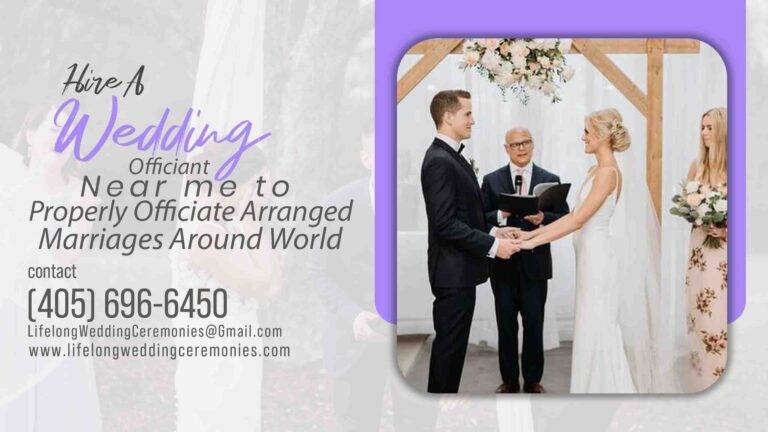
Even today, the importance of arranged marriages is widely felt amongst families across the globe. The Western marriage tradition is apparently fueled by progression in a romance and personal choice. An arranged marriage is based more on family ties, compatibility, common ideals, and the future outlook. Ordained ministers throughout Oklahoma City, Tulsa, Edmond, OK (OKC, OK), and indeed the rest of the State. Therefore, they are much more than officiants when performing arranged marriage ceremonies.
Unlike many common ceremonies that are planned just between the couple, arranged marriages may involve parents, family, and ethnic intermediaries. Sometimes with multilayered expectations that require the officiating minister to be acutely aware, patient, and flexible.
The position of ordained ministers in Oklahoma City and Tulsa, Oklahoma (OK), becomes particularly valuable within ethnically diverse communities. It’s because the rituals of arranged marriages confront the American institution of marriage as it applies in Oklahoma State laws. It also places the minister as a ceremonial guide and a legal official.
In this article, you will learn about the correct practice of arranged marriage across the world. It will include the duties of officiant ministers and the way that these ceremonies blend with modern needs.
Understanding Arranged Marriage as a Cultural System, Not a Single Practice
Before the establishment of an arranged marriage, the minister should know that “arranged marriage is not a monistic institution.” Instead, it is a broad cultural practice that is different in every culture, religion, and family. It is also based on geography, region, religion, and familial background. In South Asia, there may be a “formal arranged marriage process that includes family introduction, review by elders, and community. It can also include the ceremonial negotiation of a marriage.
Within the Middle East, there is more emphasis on family approval. It also touches on how the union will serve as an extension of a larger familial or social contract. Within parts of Africa, there may be greater community participation in arranged marriages. Within American diaspora communities in areas like Oklahoma and Tulsa, arranged marriage has developed into a combination of modern and traditional practices.
Ordained ministers in OKC, Edmond, and Tulsa, OK, will need to engage with such services with cultural sensitivity. No two arranged marriage services are alike; all such services will carry with them expectations, symbolism, and family dynamics. The most important part of a minister’s role will not be to pass judgment on the nature of such service. It will rather be to recognize it and to conduct a service rooted in respect.
Consent as the Central Ethical Requirement in Modern Arranged Marriages
It brings us to perhaps one of the most vital duties of any officiant, which is obtaining clear consent. In current marriages involving arrangements, sometimes the family is involved in making introductions. However, it is always the individuals getting married who ultimately make the decision to marry. For ministers licensed all over Oklahoma (OKC, OK), having each individual’s consent is not only the law. It is also a moral necessity for integrity in the ceremony.
This step is usually taken in private before the actual ceremony. The minister may have separate conversations with each person, checking if each person agrees and is ready for marriage. It’s not meant to pry. It is there to ensure both parties enter marriage willingly and of their free will.
In Oklahoma City multicultural ceremonies, this aspect is essential as it helps connect traditional practices with United States legal practices. An arranged marriage might have families heavily involved, but when the marriage is performed by an officiant, it needs to be affirmed individually. This gives the assurance that traditional and modern ways will complement, not collide.
The Officiant as a Cultural Translator Between Families and Ceremony
In the tradition of arranged marriage, families are frequently in control of the ceremony design, development, and execution. This can add complexity, particularly when various cultural practices meet within a single ceremony setting. Ordained ministers in Tulsa, Edmond, and the greater Oklahoma area (OKC, OK) are commonly relied upon to be cultural liaisons. It’s not to alter practices but to assist in understanding where they are comfortably implemented within the structure of the ceremony.
The families might have particular rituals, blessings, or an order they expect the couple to follow. This is something the minister may not be familiar with, nor their new spouse, from a different cultural background. This requires him/her to take into consideration their feelings and orchestrate the proceedings.
In most cases, most arrangements consist of various layers of significance that need to be conducted smoothly. Otherwise, the proceedings may become chaotic and disorganized without proper conduct. This officiant needs to acknowledge each cultural tradition and still keep the procedures comprehensible. It requires tact. There is no question of domination, but of coordination.
Structuring Complex Ceremonies Without Losing Cultural Meaning
The structure of an arranged marriage ceremony can also contain more parts than the average wedding conducted in the Western tradition. Typical ceremony elements might include presentations, familial blessings, native traditions, gifts of love, formal pronouncements, and ring-exchanging ceremonies. It is an ordained minister’s foremost duty in OKC, Tulsa, and Edmond, OK, to correctly form the ceremony.
The flow and order of a well-constructed ceremony allow each element its due and its importance. You can avoid overlap, awkwardness, or hastiness. The task is to keep emotions flowing while respecting order according to tradition.
Typically, ministers work with families to establish ceremony order in advance. This involves recognizing what events are ceremonial, which are symbolic, and which must be included to satisfy legal requirements. An arranged marriage ceremony properly sequenced feels considered, even with its multiplicity of events. Each point leads purposefully to the next.
Managing Family Dynamics Without Disrupting Ceremony Flow
The role of family is one of the defining aspects of an arranged marriage. Parents, elderly members, and extended family play a role in the marriage and the process. Although this role is a cultural staple, it has the potential to lead to an overwhelming amount of logistics and emotional involvement.
With ordained ministers in Edmond, Oklahoma City, and Tulsa, OK, the ministers must balance these traditions appropriately, respecting the participation of families while still keeping the focus on the couple.
Typically, there will be blessings or speeches or actions performed by families during an arranged marriage ceremony, and the ordained minister keeps these moments in context and still within a marriage ceremony. These actions are an essential balance that makes the ceremony a commitment between two people, while still honouring cultural hierarchy.
Emotional Tone and Cultural Expression in Arranged Marriage Ceremonies
The emotional atmosphere surrounding arranged marriages can sometimes differ greatly from the typical romantic-first type of Western wedding. It progresses with the attention focused on dignity, harmony of families, unity, and the future, rather than on building emotion or personal stories.
When ministering to couples arranging their marriage, ordained ministers must be willing and able to adjust to the expected atmosphere. It’s usually like this in Oklahoma City, Tulsa, Edmond, and throughout Oklahoma (OKC, OK). The effective officiant does not dictate the emotions that the family is to express. Rather, he reflects the family’s culture of ceremony.
Sometimes that culture requires a more formalised, structured approach, and at others it calls for warmth and receptivity. Emotionalism in arranged marriages is incredibly diverse. Some ceremonies are very effusive and festive. Some are sombre. The minister needs to be flexible. Authenticity-not affectation-is the goal.
Legal Framework and Marriage Validity Requirements in the United States
All civil marriage ceremonies conducted within the United States must be in compliance with the state’s marriage laws. This is regardless of any tradition, including verifying the bride and groom’s identity and confirming their agreement with legal documentation. It is the job of a wedding minister to handle the legalities of marriage.
All these hold ground in whether in OKC, Tulsa, Edmond, or all of OK. These aspects of the ceremony include explaining the legally binding contract to the couple and witnessing their declaration to marry. It also includes submitting papers required by the state in order to get the marriage certificate.
While cultural rituals may differ dramatically, the legal aspects of a wedding ceremony do not change. The officiant ensures that law and tradition go hand-in-hand rather than in opposite directions. The dual responsibilities of the officiant in this capacity are arguably one of the most significant aspects of officiating an arranged marriage ceremony in the U.S.
Modern Adaptations of Arranged Marriage Ceremonies in Multicultural Communities
This traditional arrangement type of marriage has transformed in many modern situations today. In cities such as OKC and Tulsa, legal procedures and individual needs happen in a single union ceremony. It blends into the hybrid arrangement ceremony where traditions and customs hold their ground.
Ministers in Oklahoma (OKC, OK) see the ceremony as incorporating both family involvement in the arrangement and modern personalisation into the service. Couples might include the family’s blessings with the personal vows. The family might include introductions, while the couple exchanges personal vows with each other.
These kinds of unions result in ceremonies that are respectful of traditions, but at the same time are personal to the individuals. The officiant should help in such a manner that it shows that every element of the ceremony matters.
Real Ceremony Flow Example: How to Officiate an Arranged Marriages
For a look at how arrangements for marriage officiating happen, here is how a ceremony handled by ordained ministers in Oklahoma City, Tulsa, and Edmond, OK, goes. The ceremony generally starts with a formal introduction of the families involved. This gives a level of respect and awareness of the importance of family.
Following the introduction, there may be a cultural or religious blessing delivered by elders or family members. Following this, the official will then lead the formal legal section of the ceremony. This involves confirmation of assent and a marriage declaration.
After this, some symbolic rituals come next, varying greatly according to culture. This is often where ring exchange, or blessings/ceremonial deeds, happen. Finally, the official declares the couple married. The format is highly customizable, but is usually fairly rigid with the aim of honouring culture whilst upholding the law.
Challenges Ordained Ministers May Face and How They Navigate Them
Administering orchestrated marriages comes with its own special set of situations. You may need to consider conflicting family expectations, multicultural and/or multilingual events, or confusing wedding ceremony procedures. You, as an ordained minister in OKC, OK, and the Tulsa, Edmond, and all Oklahoma areas, need to deal with these concerns patiently.
Miscommunication is generally the greatest danger. This is the purpose of the meeting before the ceremony, where the minister gets clear expectations from the wedding couple. Cultural neutrality can be another difficult area where the officiant must show respect but remain neutral in their views and neither endorse nor slight any cultural traditions.
Final Thoughts
The task of a minister officiating an arranged marriage goes beyond mere ceremony performance. It requires cultural comprehension, moral accountability, systematic arrangement, and emotional awareness. Ministers in Oklahoma City, Tulsa, Edmond, and Oklahoma are those who combine the spiritual, the legal, and the humane in a ritualistic framework of arranged unions.
Arranged marriage is not a thing of the past, nor is it a ceremony that is out of fashion. It is a living culture that is continuing to grow in our communities all over the world, as well as in the multicultural communities of the present. A well-arranged marriage can symbolise family togetherness, cultural values, and commitment from an individual.
An officiant of an arranged marriage cannot just simplify tradition and add modern complexity. There needs to be a careful balance of the two to truly honour the participants and make their day truly special. It is the role of an ordained minister not only to perform the ceremony but also to maintain meaning with the use of modern language.