Weddings today have the tendency to be elaborate, polished, and constructed on timelines, photo ops, and the guest experience. They are meant to be faultless. However, when the wedding officiant in Oklahoma City considers the aspects of a ceremony that have the most lasting and fondest memories decades later, they mention a single, much simpler aspect.
There was no emphasis on being perfect and a performer in the Medieval wedding ceremony. It was about having a deep symbolism, participating in each act, and feeling each moment of significance. Each moment contained a larger meaning than that shared by the wedding couple.
8 of the Best Medieval Wedding Traditions Modern Couples Should Still Use Today
Today, couples aren’t trying to turn back time exactly. Instead, they are seeking ways to add significance, a sense of roots. The experience of the ceremony can feel more like a performance. That’s where, in Tulsa, OK, and Oklahoma City, OK, wedding officiants are beginning to incorporate these medieval traditions into ceremonies. They do it in thoughtful, flexible ways.
The power remains because they take time out. They create a ceremony rather than just a wedding day. Having each of these traditions as a part of your wedding ceremony can make it a statement piece in the memory of the couples. They re-ground the couple in the meaning of the event rather than just in the image of the ceremony. Here are eight medieval wedding traditions that retain much of their meaning for contemporary couples in modern settings.
Handfasting as a Physical Expression of Unity and Commitment
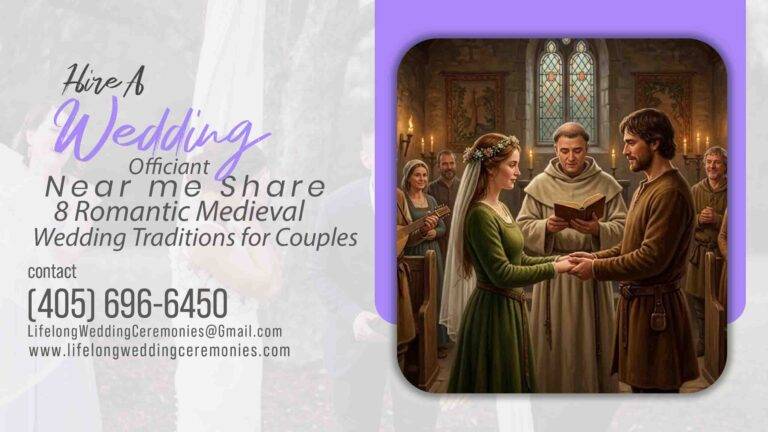
The handfasting ceremony is one of the best-known medieval wedding traditions still widely observed today. It is used for a number of good reasons and creates a physical manifestation of promises being made during ceremonies. In traditional ceremonies, the man and the woman placed their hands on top of each other and were tied together with cords. Sometimes they use ribbons to represent unity and their commitment to one another, as well as to sharing a common life.
Today, it is a common part of modern wedding ceremony vows. It can also be included as a unity ritual by Oklahoma City, Edmond, and Tulsa, Oklahoma, officiants. For other couples, it acts as an alternative to wedding rings; others incorporate handfasting and wedding rings into the ceremony.
The moment when the hands of the couple are tied together automatically slows down the wedding. It allows the emphasis to shift away from the crowd and the ceremony, and towards present existence and emotion. The couple is not just saying vows; they are enacting them in the here and now.
With weddings in Edmond and Norman, you have couples who will choose to decorate the handfasting ribbons. They do it with colours significant to the couple’s lives. Others will select colours important to aspects like loyalty, development, or strength. Others simply select earth-tones for a medieval, earthy feel.
The Tulsa and OKC area wedding officiants also use a description. The description is “the most centring part of the ceremony” because of the enforced stillness. So often, wedding ceremonies move fast, but handfasting really provides a still and profound part to the ceremony.
Ring Blessings That Transform Guests Into Participants
For most of our modern weddings, the act of exchanging rings is purely between you and your significant other. Your friends and family quietly witness this private moment as you speak your vows. They celebrate the moment with you and your partner as the two of you become one.
In many historical practices, rings were blessed by all present and then passed back to be exchanged by the couple. It ends up transforming it into a community event. Today, our wedding officiants in Oklahoma City, Edmond, and Tulsa, OK, do many ceremonies like this. They are ceremonies where guests are invited to participate in silent or vocal blessings prior to the rings being exchanged.
This is done in many forms. Some officiants ask the attendees to pause with a silent intention. Others ask for a sentence or group statement for the couple’s future life. It is implemented differently, but it is with the same feeling that the couple has a group standing behind them.
For Oklahoma City weddings, it can be an element that alters the mood of the entire service. Attendees go from passive onlookers to active participants. The profound meaning of the tradition “community”. Marriage isn’t just an agreement that is just between two people. It’s a covenant that is made before their family, friends, and community. The blessing of the rings makes it visible.
Cloaks, Fabric, and Symbolic Garments That Represent Shared Identity
During medieval rituals, garments, like cloaks or shawls, also represented more than just apparel. They also represented unity and protection. These ceremonial garments make up a huge part of such ceremonies; they also represent symbols of things, like transitional processes.
Today, couples have found different ways to express this concept with new and interesting twists on traditional marriage ceremonies. Wedding officiants in Edmond, OK City, and Tulsa, OK will have couples include clothes, cloaks, or ceremonial shawls. It can take its position over both spouses as they repeat vows. It can also function as part of a unification ritual at the wedding ceremony.
The symbol is effective because it makes shared life tangible. “We are united,” rather than stated, transitions into a physical event where lovers come together. For the Oklahoma wedding of couples, couples use fabrics which are of familial value, like a family textile, a made-to-order fabric, or simply a muted colour which emphasizes the unity rather than ornament. One reason that this ceremony matters is that emotion is conveyed implicitly rather than verbally.
Communal Feasts That Focus on Connection Instead of Structure
The communal nature of medieval weddings was quite different from today. Weddings did not feature fixed courses of plated dinners with table seating charts, but a communal celebration, the reception, where guests mingled with one another and meandered at their will.
In modern times, many of the Tulsa, OK, and OKC/Edmond wedding officiants in Oklahoma have been working with couples. It’s to rearrange the wedding reception settings with the medieval wedding in mind. In this setup, there is no assigned seating. Instead of a multi-course dinner (e.g., appetizers, then entree), guests share the meal at long family-style table settings. There is also a setting done by passing food around with buffet/family-style service.
This type of wedding setup, in particular in the Edmond/Norman area, results in a much warmer and relaxed emotional feel for not only the families but also the guests. The guests stay close, and conversations spill between the families as well as into friendships. This tradition works because it doesn’t feel like forced separation. A wedding feels much more like a communal gathering than two or more separate groups of people interacting in a wedding style.
Nature-Based Ceremonies That Integrate Environment and Emotion
During the medieval ages, wedding ceremonies aligned closely with nature. They occurred in outdoor settings such as fields, courtyards, gardens, or just open fields, so the settings themselves were part of the celebration. Now, couples are returning to this more often. Officiants at weddings are recommending outdoor weddings that mirror the surrounding nature and seasons to couples across Oklahoma City, Edmond, Tulsa, and the rest of the OK.
Spring ceremonies are about rebirth. Summer ceremonies are about openness. Fall ceremonies are about maturity and reflection. Winter ceremonies are about stillness. Nature ceremonies are impactful because they eliminate structure and artificial details that usually add to a ceremony but take the couple out of their experience. Officiants at Oklahoma City and Tulsa outdoor ceremonies comment that nature’s elements – wind, sun, changing light – do not detract from emotion but enhance it. This method works because it recaptures honesty in ceremonies.
Storytelling Vows That Turn Marriage Into a Shared Narrative
For members of communities in medieval society, passing stories around and learning from those stories was a way to connect to their relationships, their communities, and their sense of self. Stories survived in the memories of community members, all the way down through oral telling. Wedding rituals and ceremonies today are re-engaging this element by adding storytelling to wedding vows.
In OK City, Tulsa, & Edmond, OK, couples who work with an officiant to have their wedding officiated can have their officiant propose. They might also permit the officiant to officiate by telling their own story rather than simply reading the vows. This can consist of anecdotes regarding how you met and struggles you’ve experienced as a couple.
Telling a story in the vows will make for a truly remarkable ceremony, moving past just the promises. It takes the guests on an emotional experience with the couple. The guests aren’t just hearing promises made to each other. They are hearing why those promises matter. Oklahoma weddings often find this as the most emotional moment of the ceremony because it brings people together through story.
Candlelight and Fire Rituals That Symbolise Shared Life
Fire has always had ceremonial significance. For many years, as in medieval traditions, candles and flames symbolized togetherness, warmth, and eternal life. The custom continues today with couples using a unity candle, a lantern lighting, or by lighting individual candles, which is symbolic of the new union.
In Edmond, Norman, and Oklahoma City, OK, officiants may instruct a couple to use a candle lighting ceremony where they light the two candles individually and then blow them out, and then relight a single candle from both. It is a relatively basic but strong image. It conveys two separate lives uniting while still being distinct.
With some Tulsa outdoor weddings, it carries over to nighttime events via candles and lanterns and low flame accents that cast a warmth to reflect the mood of the evening. This is effective as the guests tend to focus on the visual elements. A natural pause occurs, and the event seems to become centered and especially memorable.
Community Participation That Turns Guests Into Emotional Witnesses
One of the great things about weddings of the medieval era was the level of community involvement. A medieval wedding guest not only witnessed the ceremony but also participated, through a word, blessing, response, or action.
This same principle is, bit by bit, returning to modern-day couples. Oklahoma City wedding officiants, and those serving Tulsa, Edmond, and throughout Oklahoma, have begun asking guests to take part in small but significant moments of wedding ceremony participation.
Why Medieval Wedding Traditions Still Work in Modern Ceremonies
It is partly because traditional medieval weddings valued meaning above appearance that they continue to resonate; they valued presence and the shared experience and symbolism of events above the outward and visual success of them. Modern weddings rely heavily on choreography and coordination, while their visual success deserves value. These values can diminish the emotional substance of the wedding ceremony.
Wedding officiants throughout OKC, OK, and the surrounding cities, such as Tulsa and Edmond, often guide couples through the use of blending modern structure with symbolic elements of medieval tradition into the ceremony, thereby resulting in a well-ordered and emotionally compelling ceremony.
How this works is by slowing things down. It makes rituals significant and emotionalizes each physical act of a ritual. In some cases, this stands dismissed as simply a ritualistic step. It also allows for spontaneity and a space in which one can share feelings authentically rather than in a performed and familiar manner.
To Wrap It Up
Fundamentally, weddings aren’t merely events. Weddings are transformations. They are about devotion, personality, and co-existence. This is why wedding officiants in Tulsa, Oklahoma City, Edmond, and, in fact, throughout the state of Oklahoma are constantly seeking their roots within the framework of medieval times.
These traditions are not about looking back. They’re about finding richness in the present moment. Thoughtfully executed, they turn a ceremony into a heartfelt and cherished memory for those who experience it, and it’s for that reason that traditions last.

